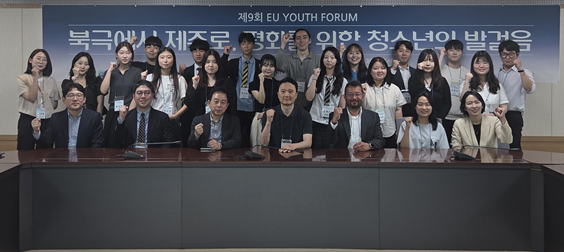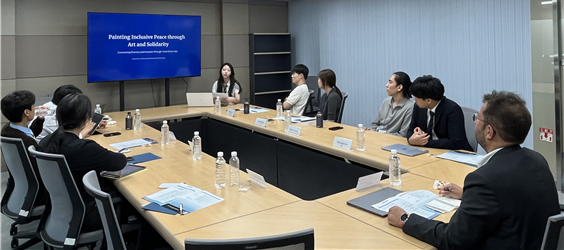
The Jean Monnet EU Centre at Hankuk University of Foreign Studies held the 9th EU Youth Forum at the Jeju International Peace Center on June 28.
The forum was organized by the Jean Monnet EU Centre in cooperation with the Institute of EU Studies and the Polar Research Center at Hankuk University of Foreign Studies. It was supported by the Korea Arctic Research Consortium, Korea Polar Research Institute, EURAXESS, Jeju International Peace Center, Seoul Institute of Global Affairs, Chonnam National University, Korea-Sakha Friendship Association, Jeju National University, Jeju Unification Education Center, and the National Research Foundation of Korea.
Held under the theme, “From the Arctic to Jeju: Youth Steps Toward Peace,” the forum brought together young people to discuss peace, climate change, migration, coexistence, and the future of local communities in an international context. This year marked the ninth EU Youth Forum and the third time the event has been held in Jeju.
A total of 18 student presenters took part in the forum, including six high school students from Jeju and 12 undergraduate and graduate students from across the country. Their presentations connected issues surrounding the Arctic, Europe, and Jeju, offering thoughtful perspectives on topics that extend beyond generational and regional boundaries.
The Arctic session addressed a wide range of subjects, including the European Union’s climate leadership in the Arctic, peace and cooperation in the region, changes in Arctic security following Russia’s invasion of Ukraine, and the EU’s Arctic policy. In the English free-topic session, students presented on Arctic security and Greenlandic self-determination, Jeju haenyeo culture and green engineering, art as a means of building peace and solidarity, climate change and the sustainable future of the Global South, and changing perceptions of solidarity among immigrants.
The Korean free-topic session also reflected the diverse interests of the participating students. Presentations covered the future of international organizations and peace, representations of immigrants in Germany, possible lessons for Korea from German society, the Italian unification movement and Romantic literature, and the relationship between Earth jurisprudence and linguistic ecology through the case of Indigenous languages in Brazil.
One of the most meaningful aspects of the forum was that young people were not simply members of the audience. They led the discussions as presenters and active participants. High school students from Jeju shared the stage with university and graduate students, expressing their own views on peace and international cooperation. Students from across the country also brought fresh perspectives to major international issues, including climate change, security, migration, culture, and language.
Through the EU Youth Forum, the Jean Monnet EU Centre will continue to create opportunities for young people to engage actively with international issues and to build connections between Jeju, local communities, and the wider world.